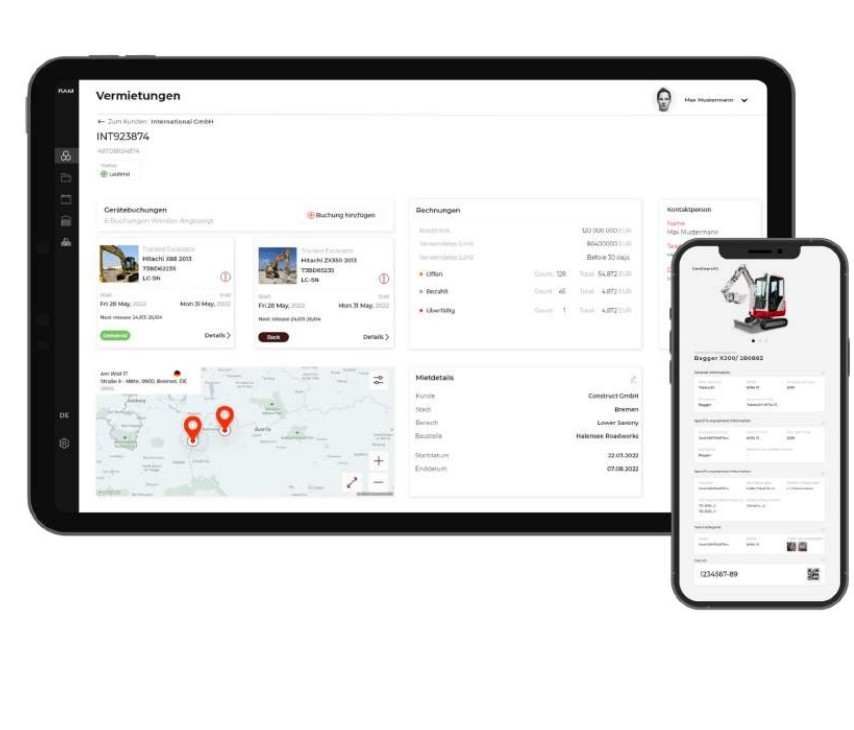
A rental company sells hours it cannot see and takes back machines it cannot inspect.
The contract says eight hours a day. The site runs twelve. Nobody counts, nobody invoices the difference, and the depot only finds out when the service interval arrives four months early.
The other leak is the return. A machine comes back with a dent, an empty tank and a fortnight of argument about which of those was already there — settled, if at all, by whoever kept better notes.
Around those two moments sits everything else: a planning board that has to show what is free and when, a catalogue holding both serialised machines and buckets of consumables, and an invoice that has to be right without anybody retyping the rental period.
Design the two edges of the contract
The middle of a rental is uneventful. The money is decided when the machine goes out, while it is running harder than agreed, and when it comes back.
Telematics does not make a rental company money. Noticing does.
Every machine in the fleet was already reporting its hours. The gap was that the number sat in a report, and a report is something you look at after the quarter it would have helped.
So overuse became a notification rather than a column — and the handover became a document the software produces rather than a form somebody is supposed to fill in.
A planning board for the day, and evidence at both ends of every rental.
The planner is where a rental company actually lives: calendar and map side by side, availability visible, and drag-and-drop for the constant reshuffling that a week of bookings really is. Reservations hold a machine before it is contracted; the same board shows ongoing, planned and completed rentals without switching context.
At the edges, handover protocols capture condition where the exchange happens, and operating hours feed straight into billing so an invoice is a consequence of the rental rather than a separate act of data entry.
Overuse is an alert, not a column in a report
Contracted hours against actual, with a notification when it slips.
Utilisation data is worthless if it is discovered late. Turning it into an automatic notice makes the difference between a conversation this week and a write-off next quarter.
The same figure serves two purposes at once — it prices the overage and it warns the depot that a service is coming early. One number, read by two people who never speak.
The handover protocol is the product's most valuable document
Condition, photographs and a customer signature, captured at the gate.
Return disputes are the expensive failure in rental and they are decided entirely by what was recorded on the way out. Making the protocol something you complete at the machine rather than at a desk is what makes it evidence rather than recollection.
It is sent to the customer for acceptance and signature and stored centrally, so the argument that used to be two people's memories becomes one document both of them agreed to.
Let the model read the photograph
Tank level, soiling and visible damage pulled from the handover images.
The person doing a handover is standing in a yard with a phone and a customer waiting. Every field they have to type is a field they will guess at, and a guessed field is not evidence.
So the obvious readings — fuel, condition, damage — are proposed from the photographs and the operator confirms or corrects them. That is the right shape for this kind of model: it drafts, a human signs, and the human is the one whose name is on the document.
Target against actual, on the customer's own project
What was rented, compared with what the site needed.
Rental companies are usually blind to how their machines are being used once they leave. Comparing the booking against the customer's project turns the platform from a ledger into an account manager's argument for the next contract.
It also surfaces the honest version of overuse: not a penalty to be charged, but a machine that was under-specified for the job.
Two kinds of thing in one catalogue
Serialised equipment with a profile; items without a serial number.
An excavator has an identity, telematics, a service history and a photograph. A box of blades has a price and a quantity. Forcing both into one record type makes one of them absurd.
So items are a separate class that links to equipment, carries graduated price lists and joins the same rental contract — which is what lets an invoice cover the machine and everything that went out on the trailer with it.
The invoice is a consequence
Rental period and rates generate the billing information; ERP takes it from there.
Every hour retyped between the planner and the accounting system is an hour that can be typed wrong. Generating billing data from the rental itself removes the transcription rather than speeding it up.
Open interfaces and AEMP 2.0 mean the figures land in whatever ERP the customer already runs, which is the only version of this that a twenty-year-old rental business will accept.
A rental fleet that reports what it earned and proves what condition it was in.
RAM runs bookings, planning, fleet, items, handovers and invoicing for rental companies including Kurt König and HOCH, with a mobile client for the yard — where the handovers actually happen.
The two edges are where the design paid: hours that were previously invisible now bill, and condition that was previously argued now has a signature on it.
What I would keep from this one
Finding the two moments that decide the money — and designing those first — was worth more than any improvement to the ninety per cent of the rental that is uneventful.
The AI in the handover is also the shape I would repeat elsewhere. It reads what is tedious and obvious, proposes it, and stops. The signature stays human, because the document only has value if somebody is accountable for it.